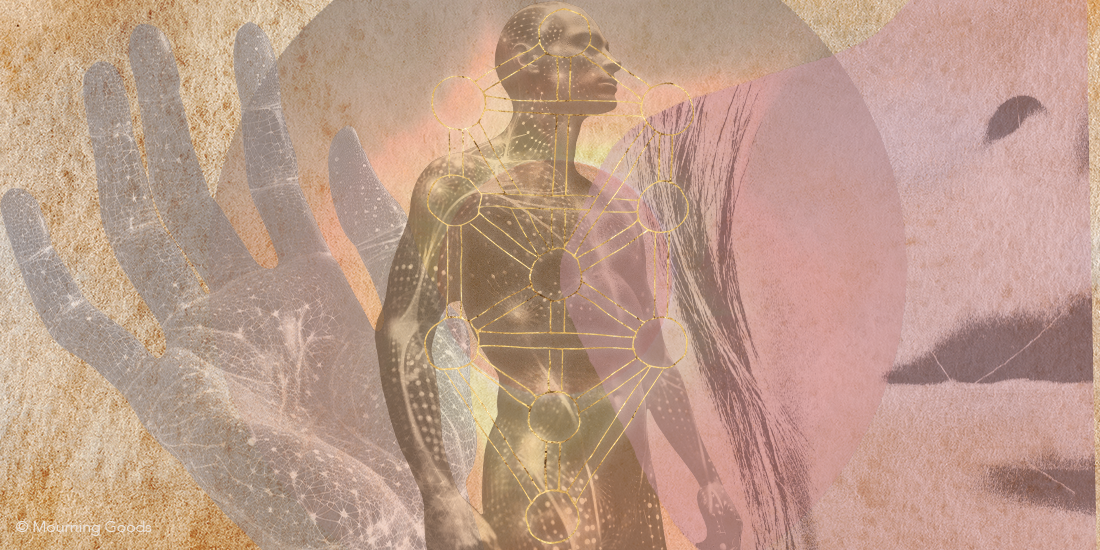
Grief doesn’t just live in the mind. It moves and is expressed and experienced through the body — in a tight chest, a heavy jaw, a stomach that won’t settle, a fatigue that sleep doesn’t touch, fascia that will not relax or release into feelings of safety, a brain that cannot stop seeking a physical presence of our Loved One. And yet so much of how we’ve been taught to grieve is entirely cerebral and often limiting, or worse, outright wrong: understand a set of stages, process the thoughts, talk it through. We’re handed lots of language and mental ‘to do’s’ for loss, but rarely a way back into the body that’s actually carrying it. People have been carrying grief since the dawn of time. Ancient people alchemized their pain, found ways to move it, feel it, honor and ritualize it, to integrate it in a healthy way within themselves and their community, to continue surviving and thriving after loss. This is not forcing healing, meaning, or growth from loss — but it is giving the pain and suffering a language and pathway to move, integrate, and evolve.
This is where embodiment work comes in.
Why the body matters in grief
In the multi-dimensional model I teach — spirit, mind, emotions, soul and body — the body is often the dimension we neglect most, and the one grief insists on the loudest. Your nervous system doesn’t process loss through analysis. It processes it through sensation: through involuntary movements like trembling, through breath, crying, raging stress hormones, through depletion and the urge to curl inward or the restlessness of whipped up energy that won’t let you sit still or find real rest. When we stay only in our heads — thinking about our grief instead of feeling it move through us — or talking about our feelings instead of feeling them — the emotion doesn’t resolve. It just gets held, waiting for a body that’s finally willing to let it come forth.
My own roots in this work go back to the early ’90s, when I trained as a bodyworker in various healing touch modalities including Craniosacral Therapy combined with hypnotherapy — termed Somato-Emotional Release Therapy — this was a powerful pairing that let my clients feel present and safe enough in their bodies to go deeper, releasing old patterns of stuckness that were affecting every part of their lives. In 1996 I founded Alternative Therapies of Del Mar, where I worked alongside respected, open-minded physicians and published psychiatrists and psychologists, marrying their traditional medicine with these non-traditional modalities to support deep emotional release and spiritual connectedness. It was a pioneering approach at the time — bridging esoteric, holistic work with scientific, allopathic medicine — and it helped me support the patients sent to me from Western traditional medical practices being treated for a wide range of issues from anxiety and depression to autoimmune disease. Eventually, I found myself treating the medical professionals themselves, and their families. Even though I mainly write, teach my conscious tools for holistic grief support, and mentor students now, at heart I am still a body worker — in awe of this miraculous system that walks our soul through the world.
Indigenous and somatic traditions have long understood what modern nervous-system science is now confirming: emotion is energy in motion. It needs a channel — movement, sound, sensation, touch — to complete itself and move through rather than lodge in place. This is the ancient foundation behind polyvagal theory, Dr. Stephen Porges’s work on how the vagus nerve governs our states of safety and threat, and of Bessel van der Kolk’s now-famous framing that “The Body Keeps the Score,” Deirdre Fay’s “Becoming Safely Embodied,” and Peter Levine’s “Waking the Tiger.”* Embodiment is simply the practice of giving grief that channel. It’s not about fixing the feeling or making it go away. It’s about letting your body do what it already knows how to do, if we stop interrupting it with thought.
These are practices I return to again and again, both in my own grief and with the people I coach. You don’t need to do all of them, and you don’t need to do them perfectly — start with whichever one your body seems to be asking for today.
Sometimes it starts with simply noticing. Instead of naming the emotion, track the physical sensation it creates. Where do you feel it in your body? Is it hot or cold, tingly, sharp, dull? Is it still, or is it moving? If it had a color or a texture, what would it be? This shifts you out of the story of the emotion and into direct contact with it, a practice that draws heavily on the work of Peter Levine, one of the main people responsible for how we understand trauma today and the founder of Somatic Experiencing. From there, ask your body how the emotion wants to move. Let the answer be subtle, a shoulder twitch, a clenched jaw, a flutter in the chest, or let it be bigger, a walk or a run if that’s what’s needed. Feel it instead of thinking it, and let yourself express it. Trauma physiologist Dr. David Berceli calls this kind of involuntary release neurogenic tremoring, part of his TRE method, the body’s own built-in mechanism for discharging stored tension.
Your hands can do a lot of this work too. One on your heart, one on your belly. Cradle your own face the way you’d cradle a child’s. Give yourself a full, real hug. Let your hands say to your body what words can’t: I’m here. You’re allowed to feel this. Deb Dana, who has translated polyvagal theory into everyday practice, calls this kind of self-touch a “glimmer,” a small, deliberate cue of safety that helps the nervous system settle. Your voice can do it too. Breathe in deep, and exhale with sound, a sigh, a groan, a moan. Scream into a pillow if it’s safe to do so. Let your throat carry what your body doesn’t have words for yet, especially when the grief is preconscious, or tangled up with trauma or pain. The vagus nerve runs directly through the throat and larynx, which is part of why humming, toning, and sighing show up across so many traditions, polyvagal-informed practice, yes, but also yoga and meditation, where the “Vu” sound is used for exactly this.
Or slow all the way down. Set a timer for two to five minutes. Sit or lie down and drop into your body. Every time you want to reach for a distraction, just notice the urge and stay a few moments longer. Ask, “Where do I want to escape to, or from?” Let whatever’s under the surface be there, without trying to change it. Don’t judge or fight the thoughts that arise, just notice them. It may feel uncomfortable at first, but it eases the more you practice, the very slow, gentle, striving-free practice of Yin Yoga is a beautiful container for this one. Grounding works in a similar register: bare feet on the ground, a hand on a tree, becoming aware of the elements or the changing seasons, naming five things you can see outside. When loss has been especially traumatic, this kind of contact with the earth offers a sense of safety and co-regulation that quiets the nervous system in ways that have spoken to us for millennia, and there’s early research on “earthing” showing measurable effects on inflammation, cortisol rhythms, and autonomic balance, which is really just science catching up to what land-based traditions have always known. Any time in nature does this: it keeps us in the present moment instead of second-guessing the past or overworking what might come.
Other days, the body wants to move, loudly. Put on a song that matches what you’re feeling, grief, anger, confusion, longing, love, joy, all of it. (It helps to build playlists for each emotion in advance.) Then move however your body wants to move. Let it get ugly, weird, chaotic, or completely still, no judgment. This isn’t about dancing well. It’s about release, and honoring, and allowing. Sometimes it becomes an interpretive dance that matches the lyrics exactly; let it. I often add creating something on top of the music, finger paint, draw, collage, tear something up and recreate it into something new. Both movement and creativity access the part of us that needs to stop judging and critiquing and just start expressing authentically. And sometimes, instead of moving the emotion that’s here, it helps to borrow from one that isn’t: recall a time you safely felt something different. A cry that helped. A moment anger protected you. A time fear kept you safe, love made you feel connected, joy meant celebration. Let that remembered version of yourself show your current body that feeling fully doesn’t mean falling apart. I like to place my hands over my heart and say out loud, “I know what it feels like to be safe. I know how it feels to be loved. I know what it feels like to feel supported.” And even if our external experience isn’t matching that, we can anchor into a time where we did know what that felt like, and let it help hold the space that is able to navigate the hardest of times.
And then there’s connection, to the animals who love us without conditions, and to sound itself. Co-regulation is embodiment too. Let the steady presence of someone, or something, you trust remind your body what safety feels like. Animals communicate with us non-consciously, through loving presence, gentle touch, quality time, play, a quiet and ancient wisdom that no talking can replace; research on the human-animal bond backs this up, finding that something as simple as a dog’s gaze raises oxytocin in both species. Sound works on us the same way: singing bowls, drumming, chanting, or simply resonant sound moving through the body as another doorway into feeling, when words fall short. Our bodies are made of water and vibrating cells, and tuning into soothing, word-free sound, from bowls, or the tides, or moving water, speaks to our system on a level words can’t reach.
None of this is about performing grief correctly, or rushing yourself toward some finish line called resolution. It’s an invitation back into a body that’s been carrying more than perhaps you’ve let yourself feel. You don’t have to think your way through loss. Your body already knows, intuitively, how to hold you and your grief in one of the safest, most sacred, most loving of spaces, if you let it lead.
~ A special note: Everyone is a unique collection of life experience and should be approached as a unique individual. Most early trauma research was conducted on male patients — often war veterans — studying testosterone-dominant nervous system responses. There is now extraordinary work emerging on how estrogen-dominant nervous systems, emotions, energy patterns, and trauma responses differ. The emerging science of how differently the body holds trauma — shaped by hormones, socialization, and lived experience — is some of the most important work happening right now. I am always adding to my own lived experience and to my knowledge by studying the latest content on embodiment, and I love these voices on Substack and Instagram — I am quite sure there are many more voices bringing this important work to the world, and would love any mentions to help me find more:
With much love,
Pamela
note: Paul Denniston is the creator of Grief Yoga, his published method for healing grief and trauma through gentle, breath-led movement. I’m certified in his Grief Movement training, which applies these same principles; gentle, easy movements and a slow pace that speaks to the parasympathetic nervous system’s need to not be rushed. His work is very effective for all ages and is a favorite of mine in acute or early grief, soon after loss, and for anticipatory grief when caretaking someone who is coming to the end of life.
References
Books
Paul Denniston, Grief Yoga (book/method); Grief Movement Certification Training
Deirdre Fay, Becoming Safely Embodied
Stephen W. Porges, The Polyvagal Theory: Neurophysiological Foundations of Emotions, Attachment, Communication, and Self-Regulation
Deb Dana, Polyvagal Practices: Anchoring the Self in Safety
David Berceli, Trauma Releasing Exercises (TRE)
Cathy Malchiodi, Trauma and Expressive Arts Therapy: Brain, Body, and Imagination in the Healing Process
Resmaa Menakem, My Grandmother’s Hands: Racialized Trauma and the Pathway to Mending Our Hearts and Bodies
Peter Levine, Waking the Tiger: Healing Trauma
Bessel van der Kolk, The Body Keeps the Score: Brain, Mind, and Body in the Healing of Trauma
Research
Chevalier, G., et al. (2015). “The Effects of Grounding (Earthing) on Inflammation, the Immune Response, Wound Healing, and Prevention and Treatment of Chronic Inflammatory and Autoimmune Diseases.” Journal of Inflammation Research.
Nagasawa, M., et al. (2015). “Oxytocin-gaze positive loop and the coevolution of human-dog bonds.” Science / PNAS.
Patrick, G. “The Effects of Vibroacoustic Music on Symptom Reduction: Inducing the Relaxation Response Through Good Vibrations.” Sound Healing Research Foundation.