Holistic Grief Support: The Chakras in Grief
The Chakras in Grief
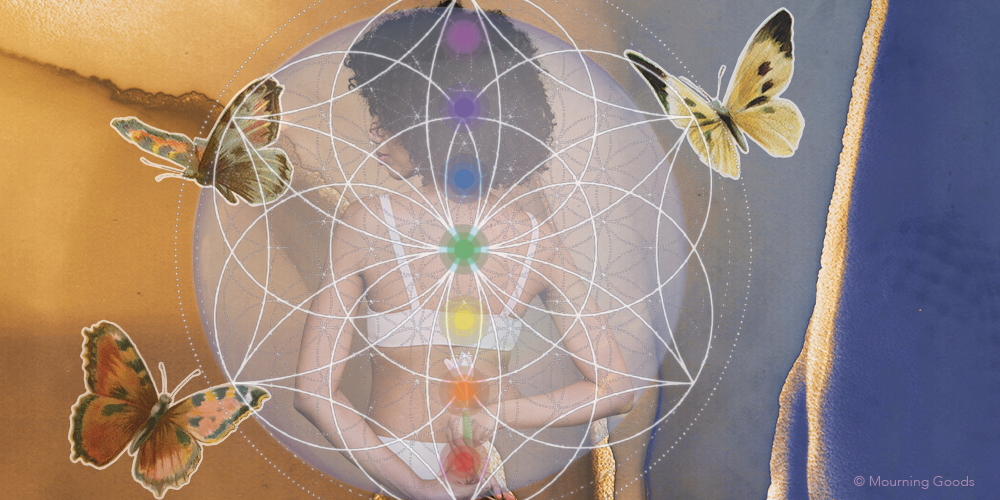
When people think about grief, they think about the heart. And yes — grief lives there. But if you've ever felt grief in your knees, in your throat, in your gut, in a fog behind your eyes that won't lift, a sense of displacement, confusion, and detachment that you can’t shake, in some higher aspect of your sense of life and self, you already know what I teach in my holistic protocol: grief doesn't live in just one place. It moves through and with your entire energetic system. It touches every layer of who you are — spirit, mind, emotions, and body — and one way to see that whole-system impact clearly is to walk it through the chakras.
We in modern day Western society have been most exposed to the Hindu chakra System. But did you know many cultures have their own versions of the chakra system that map out slightly differently? There is a Tibetan chakra system, a Hawaiian energy system with its emphasis on water, land, and sky, an Incan Bands of Power system, and many Indigenous cultures, like the Cherokee [or Tsalagi], have a similar system. Ancient wisdom often shows up in all undisturbed cultures and healing arts. I don't lean on chakra language constantly in my work. But it's a beautiful map for understanding and supporting grief holistically, because it shows grievers something they need to hear: this isn't just in your head, and it isn't just in your heart. It's everywhere in you. And that's exactly why it needs a holistic response. I train Yoga, Instructors, Sound Healers, Massage Therapists, Reiki practitioners, Energy Workers, Hypnotherapists, all kinds of Counselors and Mental Wellness Practitioners, Coaches, Death Doula, Hospice workers, Acupuncturists, and more to be Holistic Grief Coaches. I find that having a working knowledge of the chakras in grief is an accessible language that helps everyone, especially our clients.
I’ll be referencing the Hindu version of the chakra maps as most of you may be familiar with that one, so let's walk through it, one center at a time.
What Chakras Are, and How They Relate to Grief
Chakra means "wheel" or "circle" in Sanskrit, and the concept of chakras is an essential part of Hindu and Buddhist theology, and it refers to the main energy centers in the human body. In grief work, I think of chakras as containers — containers for the different aspects of a person that grief moves through and disrupts: the body, the emotions, relationships, identity, the voice, the mind's sense of meaning, and spirit.
Each chakra holds a different piece of what it means to be a whole person, and grief doesn't limit itself to just one of those containers. It moves through all of them, unevenly and in its own order, which is why a griever can feel physically unsafe one day, emotionally shut down the next, and questioning the meaning of life the day after that. Walking through the chakras one by one, the way I do below, is simply a way of naming each container clearly — so we can see exactly where grief has settled in a person and bring the right kind of support to that specific place.
The First Chakra: Safety, Embodiment, Being Here
The first chakra is your sense of safety — your sense of being here, being alive, taking up space in a body. Grief affects this directly. So does trauma, which is why the two are so often tangled together. In trauma, there's frequently a detachment from the body. Grief can do the same thing: people describe feeling like they're floating outside themselves, like they've lost their footing in their own life.
This is exactly why embodiment work, bodywork, and movement are so powerful in a holistic grief protocol. You can't think your way back into a body you've left. You have to move your way back in.
The Second Chakra: Connection, Creativity, and the Cord That Doesn't Break
The second chakra governs our relationships and our connections with others. When someone we love dies, it can feel like the cord that tethered us to them is just flying loose now, attached to nothing.
Here's what I hold as true, and what I offer my clients: love and energy never die. They transmute. You don't have to make that a religious statement or a scientific one — it can be either, both, or neither, whatever language fits you. What matters is this: at the very minimum, the love the griever had for their person, and the connection they built with them, never dies.
So a central part of the work is rebuilding that connection through creativity — because the second chakra is creativity. It's creation. It's procreation. It sits right there below the belly button. It governs our connections with others, our creativity, and the making of new life — which we'll come back to.
The Third Chakra: Identity, Ego, and Resilience
The third chakra sits at the belly, and it's our sense of identity — the self, the ego. I want to be clear that "ego" isn't a dirty word here. Ego is identity. It's a necessary part of who we are as a person.
Grief can hit this chakra hard when someone's identity was deeply fused with their role in a relationship that's now changed. I once worked with a woman in a group I wasn't facilitating, whose college-age child had died. Years after the loss — and I want to be careful here, because there's no timeline on grief, no expiration date we're waiting for — she was still deeply stuck in one specific place: the belief that she was no longer a mother.
That is a third chakra issue. To be completely clear, she was always going to grieve her daughter — that's not what was stuck. What was stuck was her identity as a mother.
Because I wasn't the facilitator, I could only point it out; I don't know what became of it, and confidentiality means I never will. But what I would have offered her is curiosity — the invitation to explore what it might mean to mother in a larger, more archetypal sense, in honor of her love for her daughter. There isn't only one way to be a mother. You can mother the world. You can mother foster children. You can mother foster kittens. There are countless ways to move that maternal energy when the one specific channel it used to flow through is gone. Without that opening, she was stuck — and stuck is its own kind of torture, because she only had access to one finite way of being who she was.
The third chakra is also where our resilience lives — our ability to show up for ourselves. This matters enormously for grievers, because as much support as we want them to have — from us, from family, from community — the truth is that modern life doesn't offer much of it by default. There's no one standing on the street corner catching us. That's part of why we need more holistic grief coaches in the world. And it's why the work isn't about telling clients what to do; it's about meeting them exactly where they are, and helping them find their own relevant ways to show up for themselves — because grief in modern Western society is deeply isolating, and there simply isn't enough built-in community to catch it.
We don't live in small tribes anymore, where in the middle of the night the whole community comes into your home and rearranges every piece of furniture, so that when you wake, you see with your own eyes that everything has changed, that people know, that you are not alone in it. Maybe you're lucky enough to have something like that community now. Most of us have to build it ourselves.
The Fourth Chakra: The Heart, Love, and the Fear That Connection Is Gone
The fourth chakra is the heart — our connection to love and to the full range of our emotions. Feeling our feelings is essential to a healthy grief experience, and yet so many grievers arrive with a heart chakra that's splintered, fractured, or simply shut down. Underneath that shutdown is usually a fear: that the love and the connection are just plain gone, because the love no longer has the physical container it used to live in.
That love, that connection — it's elsewhere now. And that circles back to something I think about often: how antiseptic, removed, and hidden death has become in our culture. If you've ever sat with the empty container that is the body of someone who has died, some deep part of you knows — they're not there anymore. They've gone somewhere else.
What you believe about that "somewhere else" is entirely your business, as it is every griever's. But I do believe that connection to love and to spirit is part of a healthy, holistic grief protocol. I don't think human beings were built for nothingness. I believe we're meant to have some relationship with something larger than ourselves — call it the universe, call it a creative force, whatever fits. You don't need to put a face on it or build a religion around it. But physical, mental, emotional, and some sense of the spiritual — not the religious, the spiritual — is part of what a balanced human being needs. When someone truly believes the love is gone, that's a heart chakra issue, and it's one of the most important places to do gentle, patient work.
The Fifth Chakra: Voice, Story, and Fairness
The fifth chakra governs communication and self-expression. Grievers need to tell their stories — that need is ancient. For tens of thousands of years, storytelling around the fire was our original medicine. It's how we taught the next generation. It's what the shaman, the medicine woman, the elder of the village did: they shared stories. We are built for this. When a griever doesn't have room to express themselves, that's unhealthy, and it can block the fifth chakra.
This chakra also carries our sense of fairness and justice, and our sense of control over our own lives. So much anger lives here — that wasn't fair, my person shouldn't have died, I'm angry, and it isn't right. That anger deserves a voice, not a lid.
The Sixth Chakra: Perception, Meaning, and the Question of Why
The sixth chakra, the third eye, is our sense of reality and perception — where we fit into the scheme of things, what life is even about. If the fifth chakra says that wasn't fair, the sixth chakra asks why. Every griever wants to know why their person, why now, why this way. And one of the hardest truths of being human is that we don't get all the answers while we're incarnate in a body.
So part of the work is helping clients hold the need to know why without needing a hard answer to arrive. We help them connect to their own inner source of guidance, their own version of spirituality, their own answers — because we, as coaches, don't have the answers for them. This isn't a religious program where a pastor or a rabbi or an imam hands down the meaning. It's spiritual, not religious. We're not supplying the why. We're helping each person find their own.
The Seventh Chakra: Spirit and the Pull Toward the Loved One
The seventh chakra is our connection to spirit — to god, the universe, whatever word fits, to the creative force itself. Grief can put even deeply devout people into a spiritual crisis. I believe that with significant grief and loss, there's often a piece of us that wants to go with the person who died. I want to be very clear: I'm not talking about suicidal ideation, and I'm not talking about wanting to end one's life. I'm talking about the spirit, the life force, the current we naturally want to follow toward the ones we love. If we can't find them here, some part of us asks, then what do I do?
The work is to help our clients bring their energy back to here — back to the first chakra, back to now — and to move through whatever spiritual crisis or ennui they may be experiencing. Ennui is that "what's the point" depression: why bother going to work, why bother getting up, why bother trying, if we're all going to die anyway. Instead of that slow withdrawal from living, we want to help our clients keep engaging on every level — physically, mentally, emotionally, spiritually.
Beyond the Seven Chakras: The Soul’s Internal Alignment and Connection to All
Different traditions count the chakras differently, some teach 12 chakras that include archetypes, your connection to all existence, Your Soul’s purpose, and more. I don't use this language heavily in my day-to-day work — but working with grievers and writing this out, I felt it important to mention the 8th, 9th, 10th, 11th, and 12th chakras. These deal with the Soul’s internal alignment and connection with life, the universe and all consciousness - topics that come up in holistic grief support work. My holistic model rests on four dimensions — physical, mental, emotional, and spiritual — but there's a layer underneath all of them, which is how well those four aspects of self line up with each other. And for thousands of years cultures have used the chakras to look for imbalance and create harmony and flow between the different dimensions.
When the chakras [or dimensions] are out of alignment, problems show up. Physical symptoms. Mental symptoms like anxiety, depression, insomnia, repetitive or invasive thoughts. Emotional symptoms — numbness on one end, rage or overwhelm on the other. Most grievers walk in terrified to feel their feelings, convinced that if they let themselves feel it fully, it will never end, they'll never stop feeling that sadness. That isn't true. Feeling your emotions, in a healthy way, is exactly how you move toward balance rather than away from it.
And spiritually, this is the layer where we stay connected to our loved one — not just understanding that the connection persists, but recognizing that it can actually be built on and grown over time.
The Ongoing Connection
I have yet to meet a griever who didn't want to hear from their person after they passed. And the research backs up what grievers already sense: a striking number of people report experiencing some kind of after-death contact — a sign, a symbol, a dream, a feeling of presence.
Now, unless mediumship is your specific gift and calling, we can't promise that experience to a client. I do a great deal of intuitive work myself, and I've had plenty of experiences of my own, but I don't present myself as a medium — frankly, the pressure of guaranteeing contact with someone's loved one sounds exhausting, and it isn't the work I do. It's not something I sell or lead with in sessions.
What I can do — what all of us doing this work can do — is help our clients stay open, connected, and loving toward the person they've lost. Because the more open and connected someone is, the more these moments seem to happen. The more love is felt, the more connection is felt. And I believe that openness creates fertile ground for exactly the kind of continued connection every griever is quietly hoping for.
That's grief through the lens of the chakras — not as a rulebook, but as a map that shows what I see in this work every day: loss doesn't stay contained. It moves through your body, your relationships, your identity, your heart, your voice, your sense of meaning, your spirit, and the deep alignment underneath all of it. Which is exactly why healing has to move through all of it too.
With much love, Pamela
For Further Reading: The Research and Wisdom Behind This Work
I don't build this work from just one tradition, so if you want to go deeper, here's where a few of the ideas above come from.
Scientific & Psychological
The Body Keeps the Score by Bessel van der Kolk — the science behind why trauma and grief live in the body, not just the mind, and why embodiment work (first chakra) matters.
Waking the Tiger: Healing Trauma by Peter A. Levine — the somatic experiencing model behind nervous-system safety and embodiment.
Continuing Bonds: New Understandings of Grief by Dennis Klass, Phyllis Silverman, and Steven Nickman — the research base behind "the connection never dies" (second chakra).
Ambiguous Loss: Learning to Live with Unresolved Grief by Pauline Boss — on losses that disrupt identity and defy closure (third chakra).
Research on after-death communication, reviewed in Psychology Today — studies across different populations put the share of bereaved people reporting some form of after-death contact between roughly 31 and 82 percent, depending on the study.
Esoteric & Energetic
Anatomy of the Spirit: The Seven Stages of Power and Healing by Caroline Myss — one of the clearest bridges between the chakra system and psychological and physical healing.
Eastern Body, Western Mind: Psychology and the Chakra System as a Path to the Self by Anodea Judith — a chakra-by-chakra psychological map, close in spirit to the structure of this article.
Healing Through Yoga: Transform Loss into Empowerment by Paul Denniston, with David Kessler — the Grief Yoga method I'm certified in.
Hands of Light: Barbara Ann Brennan
Wheels of Light: Rosalyn Bruyere
The Subtle Body: An Encyclopedia of Your Energetic Anatomy: Cyndi Dale
Indigenous Wisdom
The Wild Edge of Sorrow: Rituals of Renewal and the Sacred Work of Grief by Francis Weller — grief as communal, ritual work, closest in spirit to the "tribe rearranging the furniture" image above.
Falling Out of Grace: Meditations on Loss, Healing and Wisdom by Sobonfu E. Somé — West African (Dagara) teachings on grief, ritual, and community that inform the communal and spiritual dimensions of this work.